What Is a Total Loss Appraisal Clause?
An appraisal clause is a provision in many auto insurance policies that gives you and your insurer a way to settle a disagreement over your car’s value. If your car has been totaled and you think the offer is too low, checking your policy for this provision is one of your options. It is worth reading your own policy, because not every policy includes one and the exact wording varies.
Quick note: this is about total loss, when the car is not being repaired. If your car was repaired but is now worth less, that is diminished value, a different process.
Start The Total Loss Appraisal Process
If your insurer’s offer does not look right, do not rely on guesswork. DVAC can review the valuation, identify problems, and provide an independent total loss appraisal to help you challenge a low settlement offer.
No obligation required.



A+ Rating on BBB | Servicing Clients Nationwide
Home » Total Loss Appraisal » Appraisal Clause
Key takeaways
- An appraisal clause is a provision in many auto policies for settling a disagreement over your car’s value.
- Check your own policy to see if it has one and how it works; not every policy does, and the wording varies.
- In the process, each side picks an independent appraiser, and if they cannot agree, a neutral umpire decides.
- It settles the amount (your car’s value), not whether the claim is covered or who was at fault.
- A documented independent appraisal is what you bring to that process to support your car’s real value.
What is an appraisal clause, with an example
In plain terms, the appraisal clause is the policy’s built-in tiebreaker for value. Say your insurer offers $9,000 for your totaled car but your own research says it is closer to $12,000. The appraisal clause is the process the policy lays out for resolving that gap through independent appraisers rather than a back-and-forth argument with the adjuster.
How to find the appraisal clause in your policy
Look in your auto policy under the conditions or loss settlement section, or search the document for the word appraisal. If you cannot find it, you can ask your insurer whether your policy includes an appraisal provision and how it works. Because the wording differs from policy to policy, it is worth reading yours closely before you rely on it.
How the appraisal clause process works
- You and the insurer each choose your own independent appraiser.
- The two appraisers review the vehicle and set a value for it.
- If they agree, that value settles the amount of your total loss payout.
- If they do not agree, they select a neutral third party, an umpire, whose decision on the value is binding.
- Each side usually pays its own appraiser, and the two sides share the umpire’s cost.
What the appraisal clause can and cannot settle
| The appraisal clause CAN settle | It does NOT settle |
| The dollar amount, your car’s value | Whether your claim is covered at all |
| A disagreement over actual cash value | Who was at fault for the accident |
| The total loss payout figure | Other policy or liability questions |
When it can make sense to use it
The process has a cost, so it tends to make the most sense when the gap between your number and the insurer’s is large enough to be worth it. The stronger your evidence of the car’s real value going in, the smoother it tends to go. This is general information, not legal advice, so weigh your own situation.
How an independent appraisal fits in
Whether or not you formally use the appraisal clause, the thing that moves a total loss number is documented proof of what the car was worth. An independent total loss appraisal gives you exactly that: a defensible market value you can bring to the adjuster or into the appraisal process. If you want the step-by-step, see how to dispute a total loss settlement offer, and to compare terms, here is actual cash value versus fair market value.
Get an independent total loss appraisal
If your total loss offer looks low, start your appraisal and we will give you a documented market value to support your case, whether you negotiate directly or use your policy’s appraisal clause. You can also read our look at the appraisal clause in North Carolina for a state-specific example.
Real Reviews, Real Results
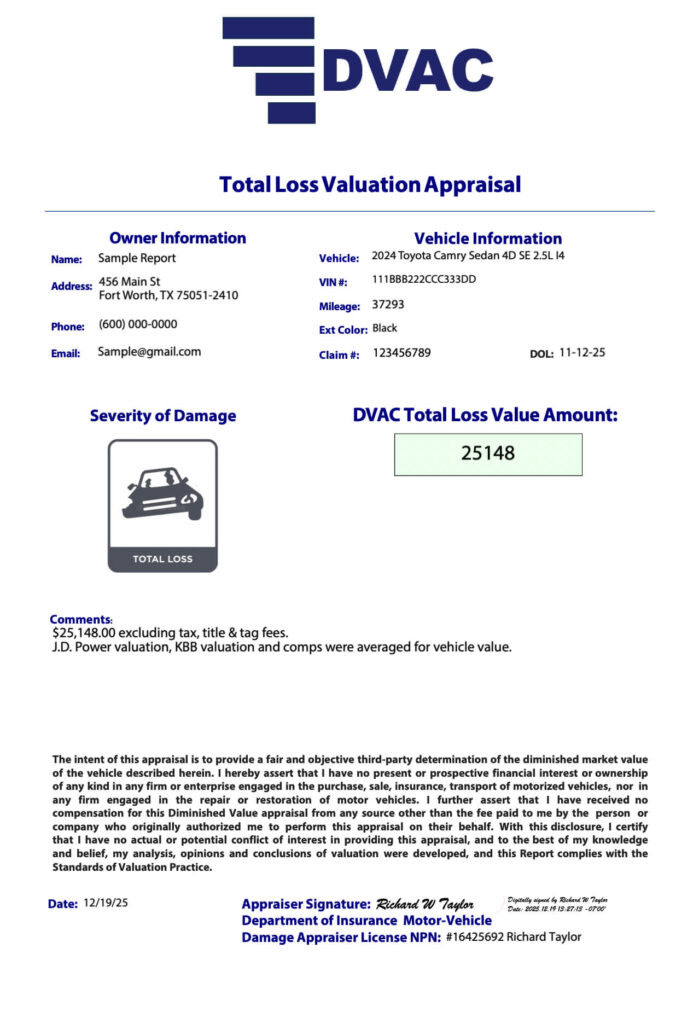
Total Loss Appraisal Report:
Wondering what’s in a DVAC appraisal? Take a look at this recent appraisal we completed for a client.