
Updated November 2026. Reviewed by Richard W. Taylor.
Your car was totaled in a crash, and the insurance adjuster just sent you a valuation. Often, the number on that report comes from CCC Intelligent Solutions, and the document is called a CCC ONE Market Valuation Report. If the figure feels lower than what your car was actually worth, you can check it line by line and push back. Here is what the report is, how CCC sets your car’s value, how it compares with Kelley Blue Book, and how to dispute a settlement offer that does not reflect your car’s real value.
What Is CCC One?
CCC ONE is software from CCC Intelligent Solutions that many insurance companies use to calculate the actual cash value (ACV) of a car after a total loss. Actual cash value is the market value of your car just before the accident. The insurer, not you, orders the report, and it often becomes the starting point for the settlement offer. If you want a plain overview of how insurers put a number on a totaled car first, see what your totaled car is worth.
What Is in a CCC ONE Market Valuation Report?
A CCC ONE Market Valuation Report is the written document behind your total loss offer. It usually includes:
- Your car’s details: year, make, model, trim, VIN and mileage.
- The options and equipment the report credits your car with.
- Condition ratings for different parts of the car.
- A list of comparable vehicles, with their prices, mileage and locations.
- Adjustments for differences between your car and each comparable.
- A final market value, and in many reports the tax and fees added to it.
Every one of those lines affects the final number, so read the whole report, not just the total.
How CCC Calculates Your Car’s Value
CCC identifies comparable vehicles, adjusts their prices for differences in mileage, options and condition, and produces a market value estimate for your car. The result depends on the quality of those inputs. Problems start when the comparables are a lower trim, carry higher mileage, or come from a market where prices run lower than yours. In that case, the math can be correct while the starting point is wrong.
CCC condition adjustments
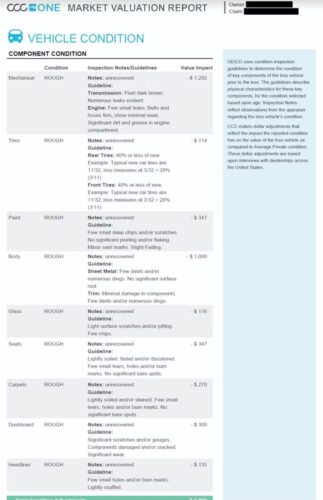
Condition adjustments are where many reports lose value. The report rates parts of your car, such as the paint, body, interior and tires, and adjusts the value up or down from a typical car of the same kind. Compare each rating with your maintenance records and photos taken before the accident. A car with new tires, a clean interior and documented service should not carry a below-average rating.
Is CCC One Accurate?
Not always. CCC ONE produces a single estimate, ordered by the insurance company that pays your claim, and the estimate is only as accurate as the comparable vehicles and adjustments behind it. That is why it is worth checking rather than accepting.
Common accuracy problems in CCC reports:
- Comparable vehicles that do not match your car’s trim level, options or mileage.
- Condition adjustments applied without clear documentation.
- Comparables from areas where prices do not reflect what your car would sell for near you.
- Missing value for factory options, aftermarket upgrades or documented service history.
If the comparables listed do not match your car, that is a strong reason to ask for a corrected valuation.
CCC Car Value vs. Kelley Blue Book: What Is the Difference?
Kelley Blue Book is a public pricing guide that estimates market value from broad data sets, and anyone can look a car up. A CCC ONE report is a proprietary valuation prepared for the insurer, built from the specific comparable vehicles and adjustments it lists. The two often produce different numbers for the same car. A Blue Book figure is a useful reference point, but it is not a rebuttal on its own. The stronger response is to show, comparable by comparable, where the CCC report undervalued your car.
How to Dispute a CCC Total Loss Valuation
You can challenge a low total loss offer. Our CCC total loss valuation dispute page covers the process in detail; here are the key steps.
Step 1: Request the full CCC ONE Market Valuation Report
Do not accept a verbal summary. Ask your adjuster for the full written report, and review the vehicle details, the comparable vehicles, the condition ratings and every adjustment behind the final figure.
Step 2: Document your vehicle’s actual condition and value
Gather records that support a higher value: maintenance logs, receipts for upgrades or recent repairs, photos from before the accident, and current listings and dealer prices for similar cars in your area.
Step 3: Get an independent total loss appraisal
An independent appraisal gives you a documented valuation built from comparable vehicles in your local market, rather than the insurer’s report. Our total loss appraisal service provides that documentation.
Step 4: Submit a formal written dispute
Use the independent appraisal to make a documented counteroffer, and put everything in writing. If the gap remains, check your policy for an appraisal clause. When it applies, each side uses its own appraiser, and the two select an umpire if they cannot agree. You stay in contact with your insurance company, and we advise you on what to say and what to do next. If the appraisal clause is invoked, DVAC negotiates and resolves the value with the third-party appraiser the insurance company hires.
What a Correct Total Loss Settlement Actually Includes
A fair total loss settlement is not just the car’s ACV. Make sure your offer accounts for:
- The actual cash value of the car.
- Sales tax on a replacement car, where your state requires it.
- Title and registration fees, where your state requires them.
- Any loan balance above the ACV, if you have gap coverage.
Many owners accept an ACV number without asking about tax, title and registration. The rules vary by state, so check your state on our total loss appraisal page.
This article covers total loss claims, where the car is not repaired. If your car was repaired after an accident but is now worth less, that is a separate process called a diminished value claim.
CCC Valuation Questions
What is a CCC ONE Market Valuation Report?
It is the written valuation many insurers use to set the actual cash value of a totaled car. It lists your car’s details, options, condition ratings, comparable vehicles and adjustments.
Why is my CCC value lower than Kelley Blue Book?
The two use different methods. A CCC report rests on the specific comparables and adjustments it lists, so check those first, because that is where a low value usually comes from.
Can I dispute a CCC valuation?
Yes. Ask for the full report, document your car’s condition and local prices, and submit a written dispute backed by an independent appraisal.
What are CCC condition adjustments?
They are the value changes the report applies after rating parts of your car, such as paint, interior and tires. Check each rating against your records and photos.
DVAC Helps Vehicle Owners Dispute Inaccurate CCC Valuations
DVAC provides independent total loss appraisals for vehicle owners nationwide. Our reports value your car using comparable vehicles in your local market and give you the documentation you need to formally dispute a low settlement offer. Reports are usually delivered within one business day.
If your insurance company gave you a CCC valuation that does not reflect what your car was actually worth, start your appraisal or call DVAC at (877) 879-0101 for a free consultation.
Here is an example of a CCC ONE Market Valuation Report page. If yours looks like this, review each comparable and adjustment before you accept the offer: