

Total Loss in Ohio: When a Car Is Totaled and What Your Car Is Worth
By Richard W. Taylor, Vehicle Appraiser.
In Ohio, there is no fixed percentage, and a car becomes salvage when the insurer declares it economically impractical to repair and pays for it. If you are at that point, here is how the rule works, how your payout is set, and what to do if the offer looks low.
Quick note: this is about total loss, when the car is not being repaired. If your car was repaired but is now worth less, that is diminished value, a different process.
What you need to know right now about an Ohio total loss
- In Ohio, there is no fixed percentage, and a car becomes salvage when the insurer declares it economically impractical to repair and pays for it.
- Your payout is based on the actual cost to buy a comparable car, less your deductible.
- If the offer looks low, you can ask for a corrected valuation and check your policy’s appraisal clause.
- An independent total loss appraisal gives you a documented Ohio market value to support your claim.
What is Ohio’s total loss threshold?
In Ohio, there is no fixed percentage, and a car becomes salvage when the insurer declares it economically impractical to repair and pays for it (Ohio Rev. Code § 4505.11(C)).
Ohio total loss at a glance
Item | Ohio |
Threshold | No fixed percentage |
What you are paid | Actual cash value of the car |
How they decide if your car is totaled in Ohio
The insurer estimates the repair cost and compares it with what it would cost to buy a comparable car, using the Ohio rule above. If you think the car was totaled too early, or should have been, ask the insurer for its repair estimate and valuation in writing.
In Ohio, if the insurer lets you keep a totaled car, it cannot pay your claim until you get a salvage certificate of title from the clerk of courts and give the insurer a copy (Ohio Rev. Code § 4505.11(C)(4)).
How your total loss payout is set
Your payout should equal what it would cost to buy the same car again today in your local Ohio market. Insurers usually set it with a third-party valuation report that compares similar local vehicles, then adjusts for your car’s details. Here is what moves the number:
What affects your payout | How it moves the number |
Mileage | Lower miles raise value; a wrong higher reading lowers it |
Condition | Clean condition raises value; heavy deductions lower it |
Trim and options | Factory options and higher trims add value, if counted |
Local market | Prices for the same car in Ohio set the baseline |
Comparison cars | The vehicles used for comparison can pull the number up or down |
What to do if your Ohio total loss offer looks low
Read the valuation report line by line and compare it to current listings for the same year, make, and model in Ohio. Look for the wrong mileage, missing options, or comparison cars that do not match yours. If your research lands above the offer, that is a strong reason to ask for a corrected valuation. Check your policy for an appraisal clause, a provision many policies include for resolving a value disagreement, and see how to dispute a total loss settlement offer step by step.
How an independent appraisal helps in Ohio
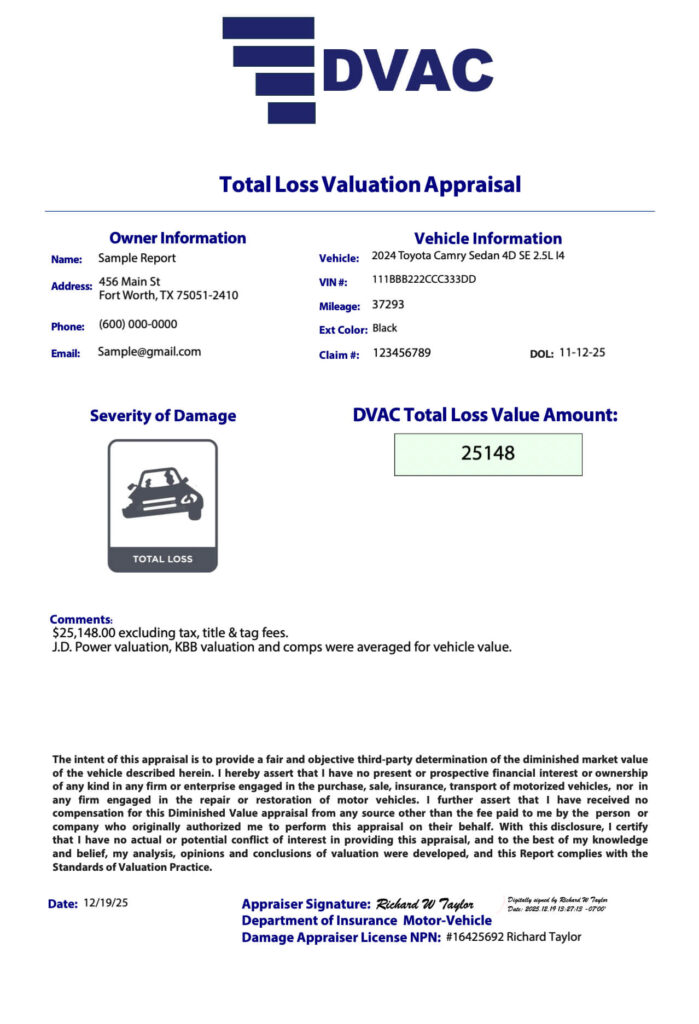
A documented appraisal is the clearest way to show a Ohio car’s real value. Our total loss appraisal service reviews your vehicle and gives you a defensible market value, the same approach we used for a total loss in Ohio. You can also look at a sample total loss appraisal report to see what the insurer receives.
Get a free Ohio total loss appraisal consultation
If your Ohio offer feels low, start your appraisal and we will give you a documented market value to support your claim.