Total Loss in Virginia: The 75% Threshold and What Your Car Is Worth
Virginia uses a 75% total loss threshold, which means your insurer can declare your car a total loss once the cost to repair it, plus its salvage value, reaches 75% of what the car is worth. If you are at that point, here is how the rule works, how your payout is set, and what to do if the offer looks low.
Quick note: this is about total loss, when the car is not being repaired. If your car was repaired but is now worth less, that is diminished value, a different process.
Start The Total Loss Appraisal Process
If your insurer’s offer does not look right, do not rely on guesswork. DVAC can review the valuation, identify problems, and provide an independent total loss appraisal to help you challenge a low settlement offer.
No obligation required.



A+ Rating on BBB | Servicing Clients Nationwide
Home » Total Loss Appraisal » Virginia Total Loss Threshold
Key takeaways
- Your payout is based on actual cash value, what your car was worth just before the accident.
- Insurers usually set that value with a vendor report (often CCC) that compares recent local sales.
- Offers often come in low because of wrong mileage, missed options, or mismatched comparison cars.
- You can check the report line by line and ask for a corrected valuation if it looks low.
- An independent total loss appraisal gives you a documented market value to bring to the insurer.
When is a car a total loss?
An insurer usually declares a total loss when the cost to repair the car, sometimes combined with its salvage value, gets close to what the car is worth. The exact cut-off varies by state. Once that happens, the insurer stops paying for repairs and instead offers to pay you the value of the car. If you are at that stage, our total loss appraisal service can help you check the offer.
How insurers decide what your totaled car is worth
The payout is based on actual cash value, the market value of your specific car right before it was damaged. To set it, most insurers use a valuation vendor, often a company called CCC, that compares recent sales and listings of similar cars in your area. The value is then adjusted for your car’s details. It is worth understanding actual cash value versus fair market value, because the two are not always the same. Here is what moves the number:
What affects your payout | How it moves the number |
Mileage | Lower miles raise value; a wrong, higher mileage reading lowers the offer |
Condition | Clean condition raises value; heavy condition deductions lower it |
Trim and options | Factory options and higher trims add value, if they are counted |
Local market | Prices for the same car in your area set the baseline |
Comparison cars | The specific listings used for comparison can pull the number up or down |
Prior history | Earlier damage or title issues can reduce the value |
What can make the payout come in low
A total loss valuation is only as good as the details behind it. Offers often come in low when the report lists the wrong mileage, misses factory options or recent work, uses comparison cars that do not really match yours, or applies heavy condition deductions. CCC valuations frequently come in below open-market value for these reasons, so it is worth reading the report closely rather than taking the first number as final.
How much will insurance pay, and how to tell if the offer is fair
The honest answer is that the payout should match what it would actually cost you to buy the same car again today, in the same condition, in your local market. To check the offer, pull up current listings for your year, make, and model nearby, then read the insurer’s valuation report line by line and look for anything wrong: mileage, trim, options, or comparison cars from far away. If your own research lands well above the offer, that is a strong reason to ask for a corrected valuation.
What to do if the number looks low
First, gather your own evidence: local listings, service records, and photos that show the real condition of your car. Check your own policy for an appraisal clause, a provision many policies include that sets out a way to resolve a value disagreement. Then an independent total loss appraisal gives you a documented, defensible market value you can bring back to the insurer. If you want help, here is how to dispute a total loss settlement offer, and if the number came from a CCC report, see our guide to a CCC total loss valuation dispute.
Who gets the check if you still owe money
If you have a loan or lease, your lender is usually paid first out of the total loss payout, and you keep whatever is left. If you owe more than the car is worth, gap insurance, if you have it, is designed to cover the difference. This is a common surprise, so it helps to know where you stand before you accept an offer.
Can you keep your totaled car?
In many cases yes. If you want to keep the car, the insurer pays you the value minus the salvage amount, and the car stays with you with a salvage or branded title. Whether that makes sense depends on the damage and what you plan to do with the car afterward.
Real results from an independent appraisal
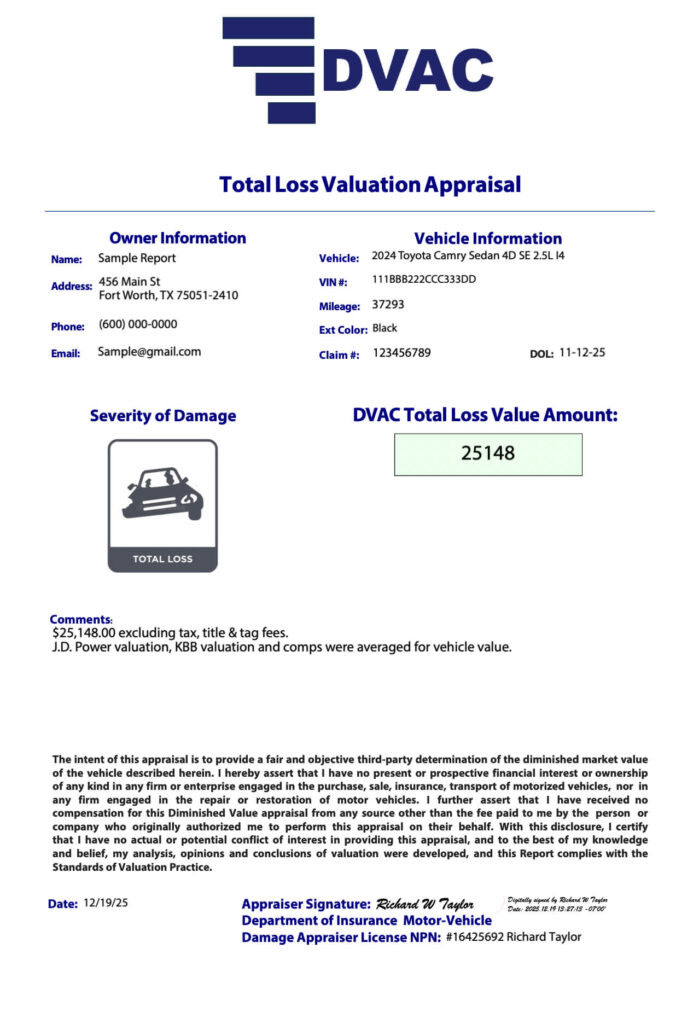
A documented appraisal can move the number in a real way. In one case we helped an owner secure $8,000 more for a totaled Toyota Sienna, and in another we helped recover an extra $9K for a totaled truck. You can also look at a sample total loss appraisal report to see exactly what the insurer receives.
Get a free total loss appraisal
If the offer on your totaled car feels low, an independent appraisal is the clearest way to find out what it is really worth. Start your appraisal and we will review your car and give you a documented market value.
Real Reviews, Real Results
Total Loss Appraisal Report:
Wondering what’s in a DVAC appraisal? Take a look at this recent appraisal we completed for a client.