Total Loss in Florida: The 80% Threshold and What Your Car Is Worth
Florida uses an 80% total loss threshold, which means your insurer can declare your car a total loss once the cost to repair it, plus its salvage value, reaches 80% of what the car is worth. If you are at that point, here is how Florida’s rule works, how your payout is set, and what to do if the offer looks low.
Quick note: this is about total loss, when the car is not being repaired. If your car was repaired but is now worth less, that is diminished value, a different process.
Start The Total Loss Appraisal Process
If your insurer’s offer does not look right, do not rely on guesswork. DVAC can review the valuation, identify problems, and provide an independent total loss appraisal to help you challenge a low settlement offer.
No obligation required.


A+ Rating on BBB | Servicing Clients Nationwide
Home » Total Loss Appraisal » Florida Total Loss Threshold
Key takeaways
- Florida uses an 80% total loss threshold: when repair cost plus salvage reaches 80% of the car’s value, the insurer can total it.
- Your payout is the car’s actual cash value, its market value just before the accident.
- In Florida you can usually keep a totaled car by taking the payout minus salvage and getting a salvage title.
- If the offer looks low, you can ask for a corrected valuation and check your policy’s appraisal clause.
- An independent total loss appraisal gives you a documented Florida market value to support your claim.
What is Florida’s total loss threshold?
Florida is a percentage-threshold state set at 80%. In plain terms, once the estimated repair cost plus the salvage value of your car reaches 80% of the car’s value, the insurer can total it instead of paying to repair it. Below that line they usually repair; at or above it they usually total. (General information based on Florida’s total loss rule; confirm the current statute for your situation.)
Florida total loss at a glance
Item | Florida |
Threshold | 80% of the car’s value |
Rule type | Percentage threshold |
What counts | Repair cost plus salvage value |
What you are paid | Actual cash value of the car |
How they decide if your car is totaled in Florida
The insurer estimates the repair cost, adds the salvage value, and compares that to your car’s actual cash value, its market value right before the accident. If the total hits 80% or more of that value, the car is a total loss under Florida’s rule. Because the whole thing rests on the car’s value, getting that number right matters, and it is worth understanding actual cash value versus fair market value.
How your total loss payout is set
Your payout should equal what it would cost to buy the same car again today in your local Florida market. Insurers usually set it with a third-party valuation report that compares similar local vehicles, then adjusts for your car’s details. Here is what moves the number:
What affects your payout | How it moves the number |
Mileage | Lower miles raise value; a wrong higher reading lowers it |
Condition | Clean condition raises value; heavy deductions lower it |
Trim and options | Factory options and higher trims add value, if counted |
Local market | Prices for the same car in Florida set the baseline |
Comparison cars | The vehicles used for comparison can pull the number up or down |
Can you keep your totaled car in Florida?
Usually yes. If you want to keep the car, the insurer pays you its value minus the salvage amount, and the car stays with you on a salvage title. Whether that makes sense depends on the damage and what you plan to do with the car.
What to do if your Florida total loss offer looks low
Read the valuation report line by line and compare it to current listings for the same year, make, and model in Florida. Look for the wrong mileage, missing options, or comparison cars that do not match yours. If your research lands above the offer, that is a strong reason to ask for a corrected valuation. Check your policy for an appraisal clause, a provision many policies include for resolving a value disagreement, and see how to dispute a total loss settlement offer step by step.
How an independent appraisal helps in Florida
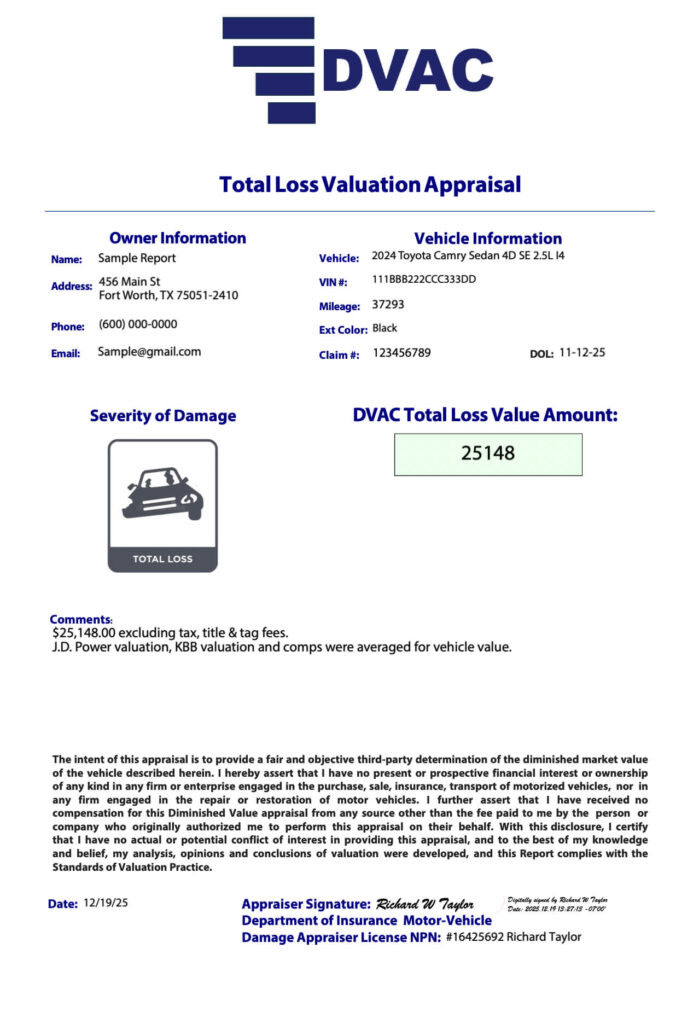
A documented appraisal is the clearest way to show a Florida car’s real value. Our total loss appraisal service reviews your vehicle and gives you a defensible market value, the same approach we used when DVAC valued a totaled vehicle in Florida. You can also look at a sample total loss appraisal report to see what the insurer receives.
Get a free Florida total loss appraisal
If your Florida offer feels low, start your appraisal and we will give you a documented market value to support your claim.
Real Reviews, Real Results
Total Loss Appraisal Report:
Wondering what’s in a DVAC appraisal? Take a look at this recent appraisal we completed for a client.