Total Loss in New York: The 75% Threshold and What Your Car Is Worth
New York treats a car as salvage when the cost to repair it is more than 75% of its pre-damage retail value. New York also has some of the most detailed rules in the country for how insurers must value a totaled car. Here is how the 75% rule works, what Regulation 64 requires of your insurer, and what to do if the offer looks low.
Quick note: this is about total loss, when the car is not being repaired. Diminished value claims are limited in New York, so if your car was repaired instead, contact us to talk through your options.
Start The Total Loss Appraisal Process
If your insurer’s offer does not look right, do not rely on guesswork. DVAC can review the valuation, identify problems, and provide an independent total loss appraisal to help you challenge a low settlement offer.
No obligation required.


A+ Rating on BBB | Servicing Clients Nationwide
Home » Total Loss Appraisal » Total Loss Appraisal in New York
Key takeaways
- New York treats a car as salvage when the repair cost is more than 75% of its pre-damage retail value.
- New York’s Regulation 64 sets exactly how insurers must value a totaled car, and the insurer must give you a detailed copy of its calculation.
- A comparable car must match your car’s make, model, year, condition and major options, with no more than 4,000 miles or 10% more mileage, whichever is greater.
- If you cannot buy a comparable car for the payout, you have 35 calendar days to tell the insurer in writing so it reopens the claim.
- If the offer looks low, an independent total loss appraisal gives you a documented New York market value to challenge it.
What is New York’s total loss threshold?
New York’s threshold is 75%. According to the New York DMV, a salvage vehicle is one with repair costs that are more than 75% of the pre-damage retail value of the vehicle, or one transferred to an insurance company with a salvage certificate (form MV-907A). New York compares the repair cost to the car’s retail value; it does not add salvage value to the repair cost. (General information, not legal advice; confirm the current rule for your situation.)
New York total loss at a glance
Item | New York |
Threshold | More than 75% |
Rule type | Percentage threshold |
What counts | Repair cost |
Compared with | Pre-damage retail value |
Comparable car | Same make, model, year, condition, major options; mileage within 4,000 miles or 10% |
Right of recourse | 35 calendar days after the payment is mailed |
Sales tax | Included, based on the pre-accident value |
What you are paid | Actual cash value of the car, less deductions |
How they decide if your car is totaled in New York
The insurer estimates the repair cost and compares it to your car’s retail value just before the accident. Once the repair estimate is more than 75% of that value, the car is treated as salvage. For example, if your car was worth $20,000 before the accident, a repair estimate above $15,000 makes it salvage in New York.
Because the whole decision rests on your car’s value, getting that number right matters. It is worth understanding actual cash value versus fair market value.
How New York requires your payout to be calculated
New York’s rules for total loss claims are in 11 NYCRR 216.7, part of Regulation 64. The insurer can replace your car with an immediately available, substantially similar car, or pay cash. For a cash offer, it must use one of these methods:
- The average of the retail values in two approved used car valuation guides, less documented dealer preparation charges of up to $100.
- A quote from a qualified dealer within 25 miles of where your car was mainly kept, for a substantially similar car that stays available for 3 calendar days after you are told about it.
- An approved computerized database that relies on values from licensed dealers.
A substantially similar car means the same make, model, year, condition and major options, with mileage no more than 4,000 miles or 10% higher than yours, whichever is greater. If an option on your car is not listed in the guides, the insurer must still consider its value. By the time it pays, the insurer must give you a detailed copy of its calculation of your car’s total loss value.
What if you cannot buy a comparable car for the offer?
New York gives you a right of recourse. If, within 35 calendar days after the claim payment is mailed, you tell the insurer in writing that you cannot buy a comparable car for that amount, the insurer must reopen the claim. It can then offer you a substantially similar car or pay the difference. Keep copies of the listings and dealer quotes you find.
Does a New York total loss payout include sales tax?
Yes. New York’s Department of Financial Services has said that sales tax is added to the car’s value before the accident, and that it is added before any deduction for salvage if you keep the car (DFS Opinion 08-10-13). The same opinion says insurers are not required to include title transfer fees, although they may choose to pay them.
Can you keep your totaled car in New York?
Yes, if the insurer agrees to let you keep it as part of the settlement. The insurer deducts the salvage value from your payout. Under Regulation 64, if you ask, the insurer must give you the name and address of a salvage buyer who will pay you the amount it deducted, with no added charges. That protects you from a salvage figure that is set too high. A rebuilt salvage vehicle must pass a DMV salvage examination before it can be titled in New York again.
What to do if your New York total loss offer looks low
Ask for the detailed calculation your insurer must provide and check it against Regulation 64. Are the comparable cars the same make, model, year and major options? Is the mileage within 4,000 miles or 10% of yours? Were options on your car left out? A CCC valuation or similar report should show all of this.
If your research lands above the offer, ask for a corrected valuation, and remember the 35-day right of recourse. Then check your policy for an appraisal clause, a provision many policies include for resolving a disagreement over value, and see how to dispute a total loss settlement offer step by step.
How an independent appraisal helps in New York
A documented appraisal is the clearest way to show a New York car’s real value. Our total loss appraisal service values your vehicle using comparable vehicles in your local market and gives you the documentation to challenge a low offer. You stay in contact with your insurance company, and we advise you on what to say and what to do next. If the appraisal clause is invoked, DVAC negotiates and resolves the value with the third-party appraiser the insurance company hires.
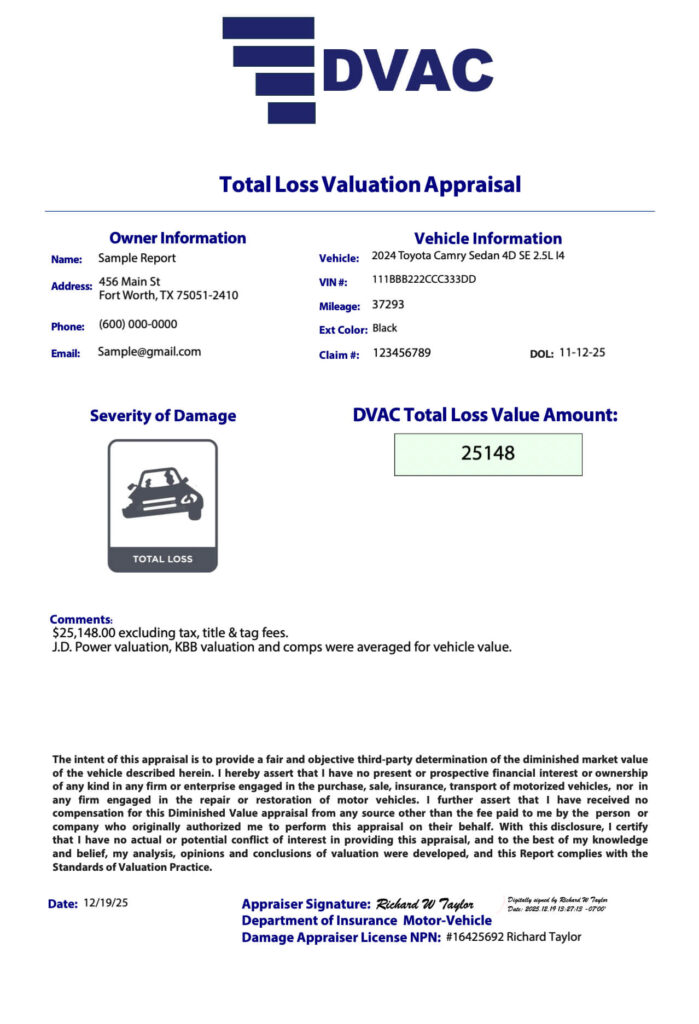
Look at a sample total loss appraisal report to see what the insurer receives, or read more about what your totaled car is worth.
New York total loss questions
Is New York a 75% total loss state?
Yes. The New York DMV treats a car as salvage when its repair costs are more than 75% of its pre-damage retail value.
How much more mileage can a comparable car have in New York?
No more than 4,000 miles or 10% more than your car, whichever is greater.
Does my New York insurer have to pay sales tax on a totaled car?
Yes. Sales tax is added to the car’s pre-accident value, before any salvage deduction. Title transfer fees are not required.
What does an insurer pay for a totaled car in New York?
The car’s actual cash value, including sales tax, less your deductible if you claim on your own policy, and less the salvage value if you keep the car. Learn more in total loss settlements: what you need to know.
Get a free New York total loss appraisal consultation
If your New York offer feels low, start your appraisal or call (877) 879-0101 for a free consultation, and we will give you a documented market value to support your claim.
Real Reviews, Real Results
Total Loss Appraisal Report:
Wondering what’s in a DVAC appraisal? Take a look at this recent appraisal we completed for a client.