Total Loss in Illinois: No Fixed Threshold, and What Your Car Is Worth
Illinois does not set a percentage total loss threshold for insured cars. Your insurer decides when a car is a total loss, and once it pays the claim, the car becomes salvage. Illinois does set detailed rules for how your payout is calculated, including taxes and fees. Here is how the decision works, what Illinois requires, and what to do if the offer looks low.
Quick note: this is about total loss, when the car is not being repaired. If your car was repaired but is now worth less, that is diminished value, a different process.
Start The Total Loss Appraisal Process
If your insurer’s offer does not look right, do not rely on guesswork. DVAC can review the valuation, identify problems, and provide an independent total loss appraisal to help you challenge a low settlement offer.
No obligation required.



A+ Rating on BBB | Servicing Clients Nationwide
Home » Total Loss Appraisal » Total Loss Appraisal in Illinois
Key takeaways
- Illinois has no fixed percentage total loss threshold for insured cars. The insurer decides when a car is a total loss.
- The 70% figure you may see online applies to self-insured companies, not to a typical driver with an insurance policy.
- Within 7 days of totaling your car, your insurer must give you written information about how the claim will be settled.
- If you buy or lease a replacement within 30 days, your insurer must reimburse the sales tax and title and transfer fees, up to the value of your totaled car.
- If the offer looks low, an independent total loss appraisal gives you a documented Illinois market value to challenge it.
What is Illinois’s total loss threshold?
Illinois does not set a percentage for insured cars. When an insurance company pays a total loss claim, the Illinois Vehicle Code treats the insurer as the owner and the car as salvage. The decision to total the car is the insurer’s.
The 70% number often quoted for Illinois comes from a different part of the same law: it applies to cars owned by self-insured companies, which must treat a car as salvage when the repair cost, including labor, would be greater than 70% of its fair market value. (Source: 625 ILCS 5/3-117.1(b). General information, not legal advice; confirm the current rule for your situation.)
Illinois total loss at a glance
Item | Illinois |
Threshold for insured cars | No fixed percentage |
Who decides | Your insurance company |
Self-insured companies | Salvage above 70% of fair market value |
Settlement information | Within 7 days of the total loss decision |
Taxes and fees | Reimbursed if you replace the car within 30 days |
Keeping the car | Only for hail damage or cars 9 model years or older, by agreement |
What you are paid | Market value of the car, less your deductible |
How they decide if your car is totaled in Illinois
Because Illinois sets no percentage for insured cars, the decision rests on your insurer’s repair estimate compared with what your car was worth before the accident. That makes your car’s value the number that matters most: a low value makes a total loss more likely and lowers your payout at the same time.
It is worth understanding actual cash value versus fair market value before you accept any figure.
How Illinois requires your payout to be calculated
Illinois has a specific rule for total loss claims on your own policy, 50 Ill. Adm. Code 919.80(c). Within 7 days of deciding your car is a total loss, the insurer must give you written information about the settlement. It then either offers a replacement car or pays cash.
For a cash settlement, the insurer must base the value on an approved source, such as:
- A computerized valuation service that uses data from the area where your car was mainly kept, adjusted for options, mileage and condition.
- A service that includes at least 2 comparable cars from licensed Illinois dealers within 50 miles, either for sale now or sold recently (one within 30 days and one within 90 days).
- If your car is not listed in any source, at least 2 written dealer quotes, with the dealers’ names and locations shared with you.
Either way, the claim file must document how the market value was determined. A replacement car must be the same manufacturer and year, with a similar body style, options and price range, in as good or better condition.
What if you cannot buy a comparable car for the offer?
Illinois gives you a right of recourse. If, within 30 days of receiving the payment, you cannot buy a comparable car for the market value the insurer set, the insurer must reopen the claim. It can then find you a comparable car at that price, pay the difference for a comparable car you found, offer a replacement, or settle the value through the appraisal section of your policy. The exception is when the insurer already gave you, at settlement, the details and VIN of a specific comparable car you could have bought for that amount.
Does an Illinois total loss payout include sales tax?
Yes, with deadlines. If you receive cash and then buy or lease a replacement car within 30 days, your insurer must reimburse the sales tax and title and transfer fees on that purchase, up to the amount tied to the value of your totaled car. You need to send proof of the purchase and the taxes and fees within 33 days of receiving the settlement, so keep your paperwork. If the insurer provides a replacement car, it pays these taxes and fees itself.
Can you keep your totaled car in Illinois?
Only in some cases. Under Illinois law, once the insurer pays a total loss claim, it becomes the owner of the car. You can keep it only by agreement with the insurer, and only if the car has hail damage alone that does not affect its safety, or the car is 9 model years old or older. If you keep it, the insurer deducts the car’s salvage value from your payout, so ask for that figure in writing first.
What to do if your Illinois total loss offer looks low
Ask for the valuation report and check it against the Illinois rule. Are the comparable cars from licensed Illinois dealers within 50 miles? Are they the same year and model, with similar options and mileage? A CCC valuation or similar report should show all of this. Look for the wrong mileage, missing options, or comparison cars that do not match yours.
If your research lands above the offer, ask for a corrected valuation, and remember the 30-day right of recourse. Then check your policy for an appraisal clause, which Illinois specifically lists as one way to settle the value, and see how to dispute a total loss settlement offer step by step.
How an independent appraisal helps in Illinois
A documented appraisal is the clearest way to show an Illinois car’s real value. Our total loss appraisal service values your vehicle using comparable vehicles in your local market and gives you the documentation to challenge a low offer. You stay in contact with your insurance company, and we advise you on what to say and what to do next. If the appraisal clause is invoked, DVAC negotiates and resolves the value with the third-party appraiser the insurance company hires.
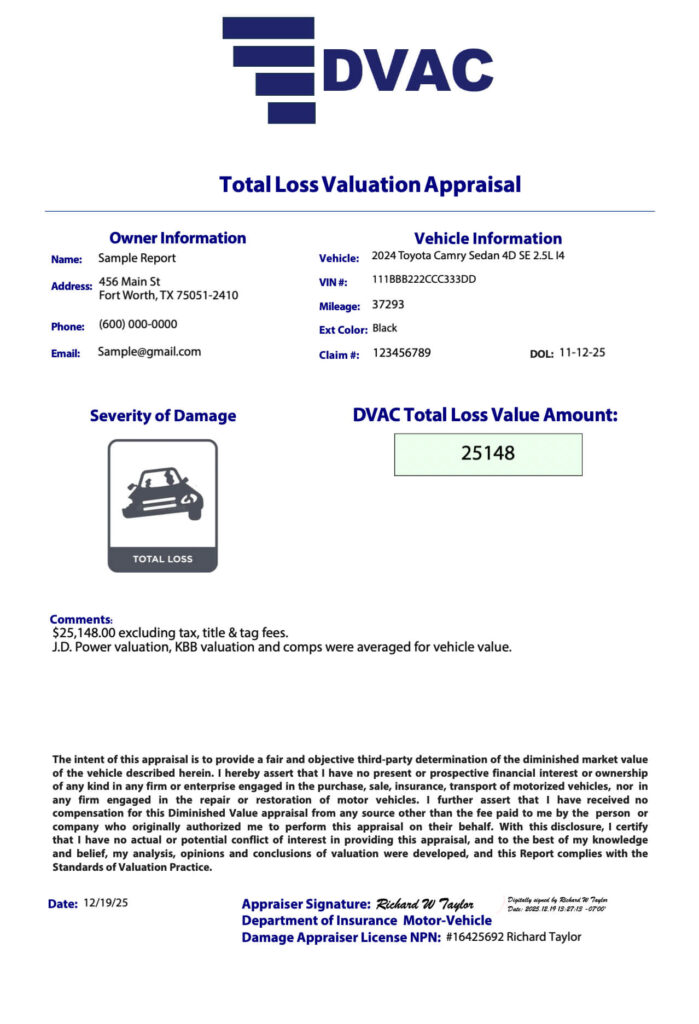
See how this worked for a 2017 Ford Escape in Illinois and a 2014 Toyota Prius owner, or look at a sample total loss appraisal report to see what the insurer receives.
Illinois total loss questions
Is Illinois a 70% total loss state?
Not for most drivers. The 70% rule applies to self-insured companies. For a car covered by an insurance policy, Illinois sets no percentage, and the insurer decides when to total it.
How long does an Illinois insurer have to explain a total loss settlement?
The insurer must give you written settlement information within 7 days of deciding your car is a total loss.
Will my Illinois insurer pay the sales tax on my next car?
Yes, if you buy or lease a replacement within 30 days of the settlement and send proof within 33 days. The reimbursement is capped at the amount tied to your totaled car’s value.
What does an insurer pay for a totaled car in Illinois?
The market value of your car, less your deductible if you claim on your own policy, plus the sales tax and fees if you replace the car in time. Learn more in total loss settlements: what you need to know.
Get a free Illinois total loss appraisal consultation
If your Illinois offer feels low, start your appraisal or call (877) 879-0101 for a free consultation, and we will give you a documented market value to support your claim.
Real Reviews, Real Results
Total Loss Appraisal Report:
Wondering what’s in a DVAC appraisal? Take a look at this recent appraisal we completed for a client.