Total Loss in South Carolina: The 75% Threshold and What Your Car Is Worth
South Carolina uses a 75% total loss threshold: your car is a total loss when the cost to repair it, including parts and labor, reaches 75% of its fair market value just before the accident. If you are at that point, here is how the rule works, when an insurer can total a car below 75%, how your payout is set, and what to do if the offer looks low.
Quick note: this is about total loss, when the car is not being repaired. If your car was repaired but is now worth less, that is diminished value, a different process.
Start The Total Loss Appraisal Process
If your insurer’s offer does not look right, do not rely on guesswork. DVAC can review the valuation, identify problems, and provide an independent total loss appraisal to help you challenge a low settlement offer.
No obligation required.


A+ Rating on BBB | Servicing Clients Nationwide
Home » Total Loss Appraisal » Total Loss Appraisal in South Carolina
Key takeaways
- South Carolina uses a 75% total loss threshold: when the repair cost reaches 75% of the car’s fair market value, the car must be declared a total loss.
- South Carolina counts the repair cost only. It does not add salvage value, as some states do.
- An insurer can also choose to total a car with less than 75% damage, or a car worth less than $2,000.
- Your payout is the car’s actual cash value, its market value just before the accident.
- If the offer looks low, an independent total loss appraisal gives you a documented South Carolina market value to challenge it.
What is South Carolina’s total loss threshold?
South Carolina’s total loss threshold is 75%. State law defines a total loss as a vehicle damaged so that the cost of repairing it, including parts and reasonable labor charges, equals or exceeds 75% of its fair market value. When an insurance company is involved, that value is set as of the date just before the accident.
The rule does not apply to vehicles worth $2,000 or less or to antique vehicles. (Source: S.C. Code Section 56-19-480(G). General information, not legal advice; confirm the current rule for your situation.)
South Carolina total loss at a glance
Item | South Carolina |
Threshold | 75% |
Rule type | Percentage threshold |
What counts | Cost of repair, parts and labor |
Compared with | Fair market value just before the accident |
Salvage value added? | No |
Not covered by the rule | Vehicles worth $2,000 or less, antique vehicles |
What you are paid | Actual cash value of the car |
How they decide if your car is totaled in South Carolina
The insurer estimates the cost to repair your car, parts and labor together, and compares it to the car’s fair market value just before the accident. If the repair estimate reaches 75% of that value, the car is a total loss. For example, if your car was worth $20,000 before the accident, it is a total loss in South Carolina once the repair estimate reaches $15,000.
Because the whole decision rests on your car’s value, getting that number right matters. It is worth understanding actual cash value versus fair market value.
Can an insurer total a car with less than 75% damage?
Yes. According to the South Carolina DMV, an insurer can choose to declare a vehicle a total loss when the damage is less than 75% of its fair market value, or when the vehicle was worth less than $2,000. The insurer files a Request for Total Loss Title (SCDMV Form TR-3) to do this. In other words, 75% is the point where South Carolina requires a total loss, not the only point where one can happen.
Can you keep your totaled car in South Carolina?
Yes. If you keep the car, the insurer files the paperwork with the SCDMV and you receive a title branded salvage. If you rebuild the car, you can submit the required documents to the SCDMV to change the brand to Salvage Rebuilt. Keeping the car usually lowers your payout, because the insurer deducts the car’s salvage value, so ask for that figure in writing before you decide.
How your total loss payout is set
Your payout should equal what it would cost to buy the same car again today in your local South Carolina market. Insurers usually set it with a third-party valuation report, such as a CCC valuation, that compares similar local vehicles, then adjusts for your car’s details. Here is what moves the number, and for a closer look, see what your totaled car is worth:
What affects your payout | How it moves the number |
Mileage | Lower miles raise value; a wrong higher reading lowers it |
Condition | Clean condition raises value; heavy deductions lower it |
Trim and options | Factory options and higher trims add value, if counted |
Local market | Prices for the same car in South Carolina set the baseline |
Comparison cars | The vehicles used for comparison can pull the number up or down |
What to do if your South Carolina total loss offer looks low
Read the valuation report line by line and compare it to current listings for the same year, make, and model in South Carolina. Look for the wrong mileage, missing options, or comparison cars that do not match yours. If your research lands above the offer, that is a strong reason to ask for a corrected valuation.
Next, check your policy for an appraisal clause, a provision many policies include for resolving a disagreement over value, and see how to dispute a total loss settlement offer step by step.
South Carolina law also lists improper claim practices, including not attempting in good faith to reach a prompt, fair, and equitable settlement once the insurer’s responsibility is clear (S.C. Code Section 38-59-20). If you believe your claim is not being handled fairly, you can file a complaint with the South Carolina Department of Insurance.
How an independent appraisal helps in South Carolina
A documented appraisal is the clearest way to show a South Carolina car’s real value. Our total loss appraisal service values your vehicle using comparable vehicles in your local market and gives you the documentation to challenge a low offer. You stay in contact with your insurance company, and we advise you on what to say and what to do next. If the appraisal clause is invoked, DVAC negotiates and resolves the value with the third-party appraiser the insurance company hires.
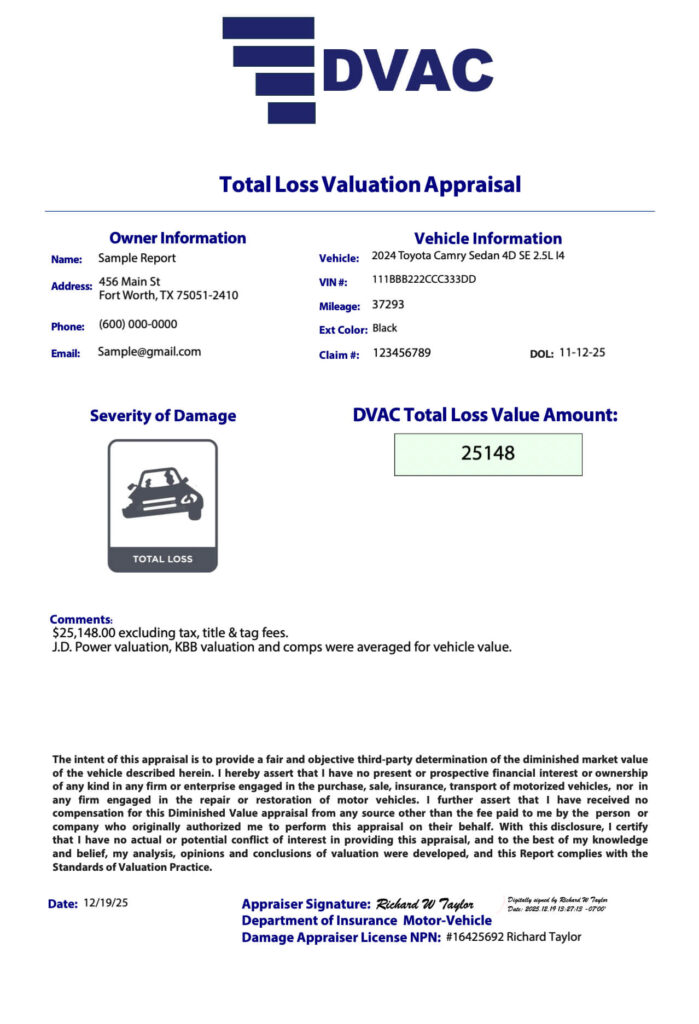
See how this worked for a Toyota Tundra owner in South Carolina, or look at a sample total loss appraisal report to see what the insurer receives.
South Carolina total loss questions
Is South Carolina a 75% total loss state?
Yes. A vehicle whose repair cost equals or exceeds 75% of its fair market value must be declared a total loss under S.C. Code Section 56-19-480(G).
Does South Carolina add salvage value to the repair cost?
No. South Carolina compares the repair cost alone, parts and labor, to the car’s fair market value.
Does the 75% rule apply to older, low-value cars?
No. The rule does not apply to vehicles worth $2,000 or less or to antique vehicles, although an insurer can still choose to total them.
What does an insurer pay for a totaled car in South Carolina?
The car’s actual cash value, its market value just before the accident, less your deductible if you claim on your own policy, and less the salvage value if you keep the car. Learn more in total loss settlements: what you need to know.
Get a free South Carolina total loss appraisal consultation
If your South Carolina offer feels low, start your appraisal or call (877) 879-0101 for a free consultation, and we will give you a documented market value to support your claim.
Real Reviews, Real Results
Total Loss Appraisal Report:
Wondering what’s in a DVAC appraisal? Take a look at this recent appraisal we completed for a client.