Total Loss in Connecticut: How Cars Are Totaled and What Your Car Is Worth
Connecticut calls a totaled car a constructive total loss: the cost to repair it, plus its salvage value, equals or exceeds what the car was worth. Connecticut also tells insurers how to value it, using at least the average of two approved pricing sources, and what they must hand you when they pay. Here is how it works and what to do if the offer looks low.
Quick note: this is about total loss, when the car is not being repaired. If your car was repaired but is now worth less, that is diminished value, a different process.
Start The Total Loss Appraisal Process
If your insurer’s offer does not look right, do not rely on guesswork. DVAC can review the valuation, identify problems, and provide an independent total loss appraisal to help you challenge a low settlement offer.
No obligation required.


A+ Rating on BBB | Servicing Clients Nationwide
Home » Total Loss Appraisal » Total Loss Appraisal in Connecticut
Key takeaways
- Connecticut uses a total loss formula: a car is a constructive total loss when the cost to repair it, to salvage it, or both, equals or exceeds its value at the time of the loss.
- The insurer must value your car at no less than the average of the retail values from two approved industry sources, such as the NADA guide and one other approved source.
- By the time it pays, the insurer must give you a detailed copy of its calculation and any non-public valuation report it used.
- It must also tell you in writing that you can dispute the amount by contacting the Consumer Affairs Division of the Connecticut Insurance Department.
- If the offer looks low, an independent total loss appraisal gives you a documented Connecticut market value to challenge it.
What is Connecticut’s total loss threshold?
Connecticut uses a total loss formula, not a fixed percentage. State law defines a constructive total loss as one where the cost to repair or salvage the damaged car, or the cost to both repair and salvage it, equals or exceeds the car’s total value at the time of the loss. (Source: CGS 38a-353. General information, not legal advice; confirm the current rule for your situation.)
Connecticut total loss at a glance
Item | Connecticut |
Threshold | Repair cost plus salvage equals or exceeds value |
Rule type | Total loss formula |
How value is set | At least the average of two approved sources |
Approved sources | NADA guide or another approved source, plus one more |
What you must receive | Detailed calculation and any non-public valuation report |
Dispute notice | Written notice to contact the Insurance Department |
Arbitration | State program for disputes over the amount |
What you are paid | Actual cash value, less your deductible |
How they decide if your car is totaled in Connecticut
The insurer adds the cost to repair your car to what the damaged car would bring as salvage, and compares that total to the car’s value at the time of the loss. If repairs plus salvage equal or exceed the value, the car is a constructive total loss. For example, if your car is worth $20,000 and the damaged car would sell for $4,000 as salvage, a repair estimate of $16,000 or more makes it a total loss in Connecticut.
Because the whole decision rests on your car’s value, getting that number right matters. It is worth understanding actual cash value versus fair market value.
How Connecticut requires your car to be valued
Connecticut is one of the few states that sets a floor on how a totaled car is valued. Under CGS 38a-353, the insurer must use at least the average of the retail values given your car by:
- The National Automobile Dealers Association used car guide, or another publicly available industry source approved by the Insurance Commissioner; and
- One other industry source approved by the Commissioner.
According to a Connecticut legislative research report, the approved sources include valuation companies such as CCC, Mitchell and Audatex, and an insurer must use its approved source consistently rather than picking one case by case. Ask which two sources your insurer used and what each one said.
What your Connecticut insurer must give you
No later than the day it pays you, the insurer must provide:
- A detailed copy of its calculation of your car’s total loss value.
- A copy of any valuation report from an industry source that is not publicly available.
- A written notice that you may dispute the amount by contacting the Consumer Affairs Division of the Insurance Department, with the division’s address, toll-free number and website.
If mediation through the Consumer Affairs Division does not resolve a dispute about the amount, the Insurance Department’s automobile arbitration program is available for private passenger cars, with a small filing fee for each side.
How your total loss payout is set
Your payout should equal what it would cost to buy the same car again today in your local Connecticut market. Valuation reports, such as a CCC valuation, compare similar vehicles and then adjust for your car’s details. Here is what moves the number, and for a closer look, see what your totaled car is worth:
What affects your payout | How it moves the number |
Mileage | Lower miles raise value; a wrong higher reading lowers it |
Condition | Clean condition raises value; heavy deductions lower it |
Trim and options | Factory options and higher trims add value, if counted |
Local market | Prices for the same car in Connecticut set the baseline |
Comparison cars | The vehicles used for comparison can pull the number up or down |
Can you keep your totaled car in Connecticut?
Often, yes, if your insurer agrees. The insurer deducts the salvage value from your payout, and the car will need a salvage title through the Connecticut DMV before it can be repaired and put back on the road. Ask for the salvage deduction in writing before you decide.
What to do if your Connecticut total loss offer looks low
Start with the detailed calculation your insurer must give you. Check that the value is at least the average of two approved sources, and compare it to current listings for the same year, make and model in Connecticut. Look for the wrong mileage, missing options, or comparison cars that do not match yours. If your research lands above the offer, ask for a corrected valuation, and contact the Insurance Department’s Consumer Affairs Division if you cannot agree.
Then check your policy for an appraisal clause, a provision many policies include for resolving a disagreement over value, and see how to dispute a total loss settlement offer step by step.
How an independent appraisal helps in Connecticut
Connecticut gives you the insurer’s full calculation, which makes it easier to see exactly where a valuation falls short. Our total loss appraisal service values your vehicle using comparable vehicles in your local market and gives you the documentation to challenge a low offer, whether with the insurer or with the Insurance Department. You stay in contact with your insurance company, and we advise you on what to say and what to do next. If the appraisal clause is invoked, DVAC negotiates and resolves the value with the third-party appraiser the insurance company hires.
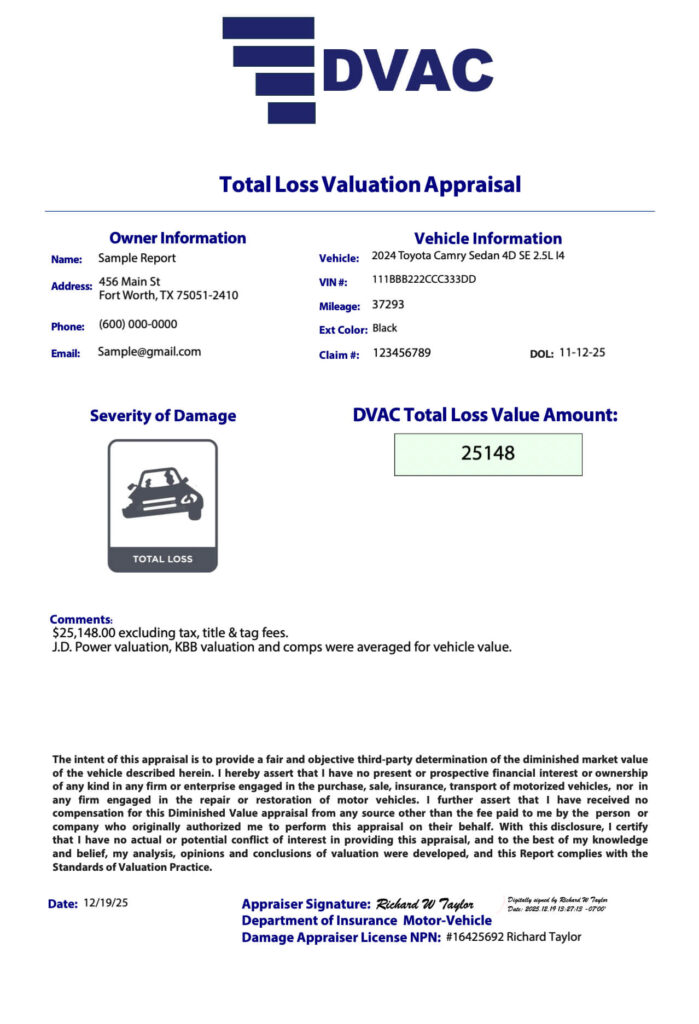
Look at a sample total loss appraisal report to see what the insurer receives.
Connecticut total loss questions
Does Connecticut have a total loss percentage?
No. Connecticut uses a total loss formula: a car is a total loss when the cost to repair it plus its salvage value equals or exceeds its value.
How must a Connecticut insurer value my totaled car?
At no less than the average of the retail values from two approved industry sources, such as the NADA guide and one other approved source.
Can I dispute my Connecticut total loss settlement?
Yes. Your insurer must tell you in writing that you can contact the Insurance Department’s Consumer Affairs Division, and the department runs an arbitration program for disputes over the amount.
What does an insurer pay for a totaled car in Connecticut?
The car’s actual cash value, less your deductible if you claim on your own policy, and less the salvage value if you keep the car. Learn more in total loss settlements: what you need to know.
Get a free Connecticut total loss appraisal consultation
If your Connecticut offer feels low, start your appraisal or call (877) 879-0101 for a free consultation, and we will give you a documented market value to support your claim.
Real Reviews, Real Results
Total Loss Appraisal Report:
Wondering what’s in a DVAC appraisal? Take a look at this recent appraisal we completed for a client.