Total Loss in Oregon: The 80% Rule Explained, and What Your Car Is Worth
Oregon’s 80% total loss rule applies to damage no insurer covers. When an insurance claim is involved, your car is totaled once the insurer declares it a total loss. Oregon then has strong rules for how insurers must value a totaled car, including paying taxes and fees and, in some cases, your appraisal costs. Here is how it works and what to do if the offer looks low.
Quick note: this is about total loss, when the car is not being repaired. If your car was repaired but is now worth less, that is diminished value, a different process.
Start The Total Loss Appraisal Process
If your insurer’s offer does not look right, do not rely on guesswork. DVAC can review the valuation, identify problems, and provide an independent total loss appraisal to help you challenge a low settlement offer.
No obligation required.



A+ Rating on BBB | Servicing Clients Nationwide
Home » Total Loss Appraisal » Total Loss Appraisal in Oregon
Key takeaways
- When an insurer covers the loss, an Oregon car is totaled once the insurer declares it a total loss. The 80% rule applies to damage no insurer covers.
- Oregon insurers must pay the applicable taxes, license fees and transfer fees on a total loss, less only your deductible.
- Your insurer must give you copies of the valuation information it used, and its database must give primary weight to cars in your local market.
- If you cannot buy a comparable car for the payout, you have 35 days to ask the insurer to reopen the claim.
- If an appraisal under your policy comes in above the insurer’s last offer, the insurer must reimburse your reasonable appraisal costs.
What is Oregon’s total loss threshold?
Oregon law defines a totaled vehicle in three ways:
- A vehicle that an insurer obligated to cover the loss declares a total loss, or takes possession of or title to.
- A stolen vehicle not recovered within 30 days, when no insurer covers the loss.
- A vehicle with damage no insurer covers, when the estimated cost to repair it equals at least 80% of its retail market value before the damage, as shown in publications relied on by financial institutions in Oregon.
So for most insurance claims, the 80% figure is not what decides it. Your insurer’s total loss decision is, which is why the value of your car matters so much. (Source: ORS 801.527. General information, not legal advice; confirm the current rule for your situation.)
Oregon total loss at a glance
Item | Oregon |
Insured claims | Totaled when the insurer declares a total loss |
Uninsured damage | Totaled at 80% of retail market value |
Taxes and fees | Insurer pays taxes, license and transfer fees |
Valuation documents | Insurer must give you copies |
Reopening the claim | Within 35 days of receiving the payment |
Appraisal costs | Reimbursed if the final value beats the insurer’s last offer |
What you are paid | What you could have sold the car for before the accident, less your deductible |
How they decide if your car is totaled in Oregon
When an insurer covers the loss, it compares its repair estimate with your car’s value and declares a total loss when repair is not practical. Because there is no set percentage for insured claims, the value of your car drives the decision: a low value makes a total loss more likely and lowers your payout at the same time. According to the Oregon Division of Financial Regulation, you are owed what you would have been able to sell your vehicle for before the accident.
It is worth understanding actual cash value versus fair market value before you accept any figure.
How Oregon requires your payout to be calculated
Oregon’s standards for total loss settlements are in OAR 836-080-0240. The insurer can offer a comparable replacement car, meaning the same make, the same or a newer year, a similar body style, options and mileage, in as good or better condition. Or it can pay cash, less your deductible, including all applicable taxes, license fees and transfer fees for a comparable car.
For a cash settlement, the value can come from a computerized database that gives primary consideration to cars in your local market, based on cars available now or within 90 days of the loss. For cars 5 model years old or newer, those values must come mainly from verifiable data or licensed dealer inventory. The insurer must give you copies of the information it used to set the amount, and any deduction for salvage, betterment or depreciation must be itemized in dollars.
What if you cannot buy a comparable car for the offer?
Oregon lets you reopen the claim. If, within 35 days of receiving the payment, you tell your insurer you cannot buy a comparable car for that amount, the insurer must reopen the file. It can then find a comparable car, pay the difference, negotiate a purchase, offer a replacement, or settle the value through your policy’s appraisal process. The exception is when the insurer already gave you written notice of a specific comparable car, with its VIN, available at the settlement value. This right applies to claims on your own policy.
If you and the insurer still disagree on the value, the insurer must pay you the amount that is not in dispute once you agree to transfer the title and let it move the car for inspection for at least 14 days.
Does Oregon reimburse appraisal costs?
Yes, in a specific case. If you disagree with your own insurer’s value and the appraisal process in your policy is used, Oregon insurers must reimburse you for reasonable appraisal costs if the final appraised value is higher than the insurer’s last offer. Typically, you and the insurer each pay for your own appraiser, and if the two disagree, they choose an umpire whose cost you split. (Source: Oregon Insurance Division, Vehicle Total Loss.)
Can you keep your totaled car in Oregon?
Yes. If you keep the car, the insurer pays you the difference between its value before the loss and its salvage value, the amount a salvage buyer would pay for the damaged car. Oregon requires that salvage deduction to be itemized and specified in dollars, so ask to see it in writing. A lienholder may not allow you to keep the car, and the insurer must notify the Oregon DMV when it totals a vehicle, so check DMV’s title rules before you decide.
What to do if your Oregon total loss offer looks low
Ask for the valuation reports your insurer must provide and check every line. Are all your car’s options listed? Are the year, make, mileage, equipment and condition right? Are the comparable cars in your area? A CCC valuation or similar report should show all of this. Then look up local listings for comparable cars and ask for the cash price, not the advertised price, and write down who you spoke to and when.
If your research lands above the offer, send it to the insurer and ask for a review, and remember the 35-day reopening right. Do not cash a check marked “full and final settlement” while you still dispute the value. Check your policy for an appraisal clause, and see how to dispute a total loss settlement offer step by step.
How an independent appraisal helps in Oregon
A documented appraisal is the clearest way to show an Oregon car’s real value, and in Oregon a successful appraisal can also get your appraisal costs reimbursed. Our total loss appraisal service values your vehicle using comparable vehicles in your local market and gives you the documentation to challenge a low offer. You stay in contact with your insurance company, and we advise you on what to say and what to do next. If the appraisal clause is invoked, DVAC negotiates and resolves the value with the third-party appraiser the insurance company hires.
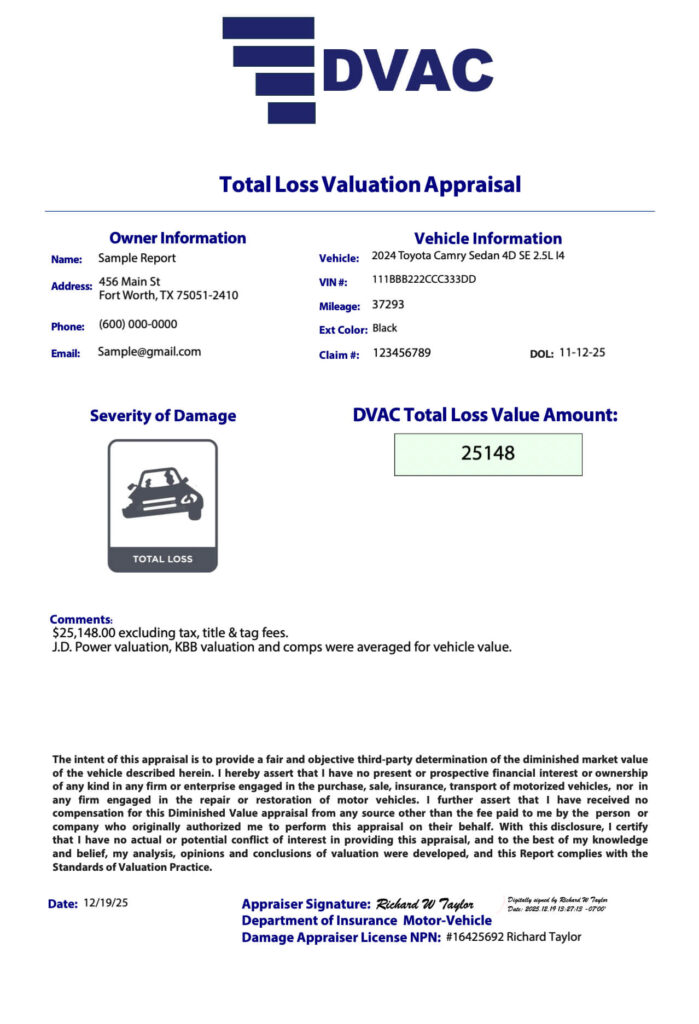
Look at a sample total loss appraisal report to see what the insurer receives, or read more about what your totaled car is worth.
Oregon total loss questions
Is Oregon an 80% total loss state?
Only for damage no insurer covers. When an insurer covers the loss, the car is totaled once the insurer declares it a total loss.
Does my Oregon insurer have to pay taxes and fees on a totaled car?
Yes. Oregon requires insurers to include all applicable taxes, license fees and transfer fees, less only your deductible.
Will my Oregon insurer pay for my appraisal?
If the final appraised value under your policy’s appraisal process is higher than the insurer’s last offer, the insurer must reimburse your reasonable appraisal costs.
What does an insurer pay for a totaled car in Oregon?
What you could have sold the car for before the accident, plus taxes and fees, less your deductible if you claim on your own policy, and less the salvage value if you keep the car. Learn more in total loss settlements: what you need to know.
Get a free Oregon total loss appraisal consultation
If your Oregon offer feels low, start your appraisal or call (877) 879-0101 for a free consultation, and we will give you a documented market value to support your claim.
Real Reviews, Real Results
Total Loss Appraisal Report:
Wondering what’s in a DVAC appraisal? Take a look at this recent appraisal we completed for a client.