Total Loss in North Carolina: The 75% Threshold and What Your Car Is Worth
North Carolina uses a 75% total loss threshold, and it is a firm one: once the damage equals or exceeds 75% of your car’s pre-accident actual cash value, your insurer must declare it a total loss. North Carolina also has detailed rules for how the payout is calculated. Here is how the rule works, what your insurer must give you, and what to do if the offer looks low.
Quick note: this is about total loss, when the car is not being repaired. If your car was repaired but is now worth less, that is diminished value, a different process.
Start The Total Loss Appraisal Process
If your insurer’s offer does not look right, do not rely on guesswork. DVAC can review the valuation, identify problems, and provide an independent total loss appraisal to help you challenge a low settlement offer.
No obligation required.


A+ Rating on BBB | Servicing Clients Nationwide
Home » Total Loss Appraisal » Total Loss Appraisal in North Carolina
Key takeaways
- North Carolina requires a total loss when the damage, including supplemental claims, equals or exceeds 75% of the car’s pre-accident actual cash value.
- No one may agree to keep a repair bill under 75% just to avoid totaling the car.
- If you and the insurer disagree on value, the offer must be based on regional average values and two or more comparable cars within 100 miles.
- Sales tax and registration fees must be included, unless you keep the car.
- If the offer looks low, an independent total loss appraisal gives you a documented North Carolina market value to challenge it.
What is North Carolina’s total loss threshold?
North Carolina’s threshold is 75%, and it is mandatory. Under the state’s total loss rule, when a car is damaged in an amount that, counting the original and any supplemental claims, equals or exceeds 75% of its pre-accident actual cash value, the insurance company shall designate it a total loss and pay the claimant the pre-accident value. The insurer then receives the title to the salvage. The rule also bars anyone from agreeing to limit a claim to keep the repair cost under 75%.
North Carolina’s motor vehicle law separately treats a car as a salvage vehicle when repairs, parts and labor, would exceed 75% of its fair retail market value, whether or not an insurer declared it a total loss. (Sources: 11 NCAC 04 .0418 and N.C.G.S. 20-4.01(33d). General information, not legal advice; confirm the current rule for your situation.)
North Carolina total loss at a glance
Item | North Carolina |
Threshold | 75% or more, mandatory |
Rule type | Percentage threshold |
What counts | Damage, including supplemental claims |
Compared with | Pre-accident actual cash value |
Comparable cars | Same make, model and year, within 100 miles |
Taxes and fees | Sales tax and registration fees included, unless you keep the car |
Payment | Within 10 business days after the claim is settled |
What you are paid | Pre-accident value plus tax and fees, less your deductible |
How they decide if your car is totaled in North Carolina
The insurer adds up the repair estimate, including any supplements found once the car is taken apart, and compares it to your car’s actual cash value before the accident. Once the damage reaches 75% of that value, the insurer must total the car. For example, if your car was worth $20,000 before the accident, damage of $15,000 or more makes it a total loss in North Carolina.
Because the whole decision rests on your car’s value, getting that number right matters. It is worth understanding actual cash value versus fair market value.
How North Carolina requires your payout to be calculated
If you and the insurer cannot agree on your car’s actual cash value, North Carolina’s rule says the settlement offer must be based on:
- The published regional average values of substantially similar cars, meaning the same make, model and year, from recognized pricing guides; and
- The retail cost of two or more substantially similar cars in your local market area, available now or within 90 days of the accident.
The local market area is a 100-mile radius of where your car is mainly kept, expanded in 50-mile steps only if no similar car can be found. If none can be found at all, the offer can be based on quotes from two or more licensed dealers in that area. The offer can be adjusted for condition, options, equipment and mileage, and for unrepaired damage from before the accident. The insurer must also consider your evidence, such as receipts and photos, that your car was in better condition than its offer suggests.
What your North Carolina insurer must give you
Every deduction, including for salvage or prior damage, must be itemized with its dollar amount, and the documentation behind the settlement must be shared with you. If you ask, the payment must come with a written statement listing the estimates, evaluations and deductions used, and the source of each value. Once the claim is settled, the payment must be mailed or delivered within 10 business days.
North Carolina’s repair estimate rule adds that the insurer must inspect the car, in person or digitally, within 10 business days of receiving the claim, must not refuse an in-person inspection if you ask for one, and must give you copies of the original and supplemental estimates on request.
Does a North Carolina total loss payout include sales tax?
Yes. Applicable sales tax and vehicle registration fees must be included as part of the actual cash value settlement, except when you keep the salvage. Check that both appear on your settlement.
Can you keep your totaled car in North Carolina?
Yes, at your choice. The insurer deducts the salvage value from the actual cash value and leaves the car with you. If you ask, the insurer must give you the name and address of a salvage dealer who will buy the car for the amount it deducted, which protects you from a salvage figure set too high. Keep in mind that keeping the car means the sales tax and registration fees are not included.
Towing and storage in North Carolina
The insurer is responsible for reasonable towing and storage charges until three days after it notifies you and the storage facility in writing that it will stop paying them. Watch for that notice so storage fees do not build up on you.
What to do if your North Carolina total loss offer looks low
Ask for the written statement of estimates, evaluations, deductions and sources. Are the comparable cars the same make, model and year? Are they within 100 miles of where your car is kept? Are the condition adjustments supported? A CCC valuation or similar report should show all of this. Send receipts, maintenance records and photos showing your car’s condition, since the insurer must consider them.
Then check your policy for an appraisal clause, and read about the appraisal clause in North Carolina and how to dispute a total loss settlement offer step by step.
How an independent appraisal helps in North Carolina
A documented appraisal is the clearest way to show a North Carolina car’s real value. Our total loss appraisal service values your vehicle using comparable vehicles in your local market and gives you the documentation to challenge a low offer. You stay in contact with your insurance company, and we advise you on what to say and what to do next. If the appraisal clause is invoked, DVAC negotiates and resolves the value with the third-party appraiser the insurance company hires.
See how this worked for a 2017 Ford Focus ST in North Carolina, or look at a sample total loss appraisal report to see what the insurer receives.
North Carolina total loss questions
Is North Carolina a 75% total loss state?
Yes. When damage equals or exceeds 75% of the car’s pre-accident actual cash value, the insurer must declare it a total loss.
How far away can a North Carolina insurer look for comparable cars?
Within 100 miles of where your car is mainly kept, widened in 50-mile steps only if no similar car can be found.
Does my North Carolina insurer have to pay sales tax on a totaled car?
Yes. Sales tax and registration fees are included, unless you keep the salvage.
What does an insurer pay for a totaled car in North Carolina?
The car’s pre-accident actual cash value plus sales tax and registration fees, less your deductible if you claim on your own policy. If you keep the car, the salvage value is deducted and the tax and fees are not included. Learn more in total loss settlements: what you need to know.
Get a free North Carolina total loss appraisal consultation
If your North Carolina offer feels low, start your appraisal or call (877) 879-0101 for a free consultation, and we will give you a documented market value to support your claim.
Real Reviews, Real Results
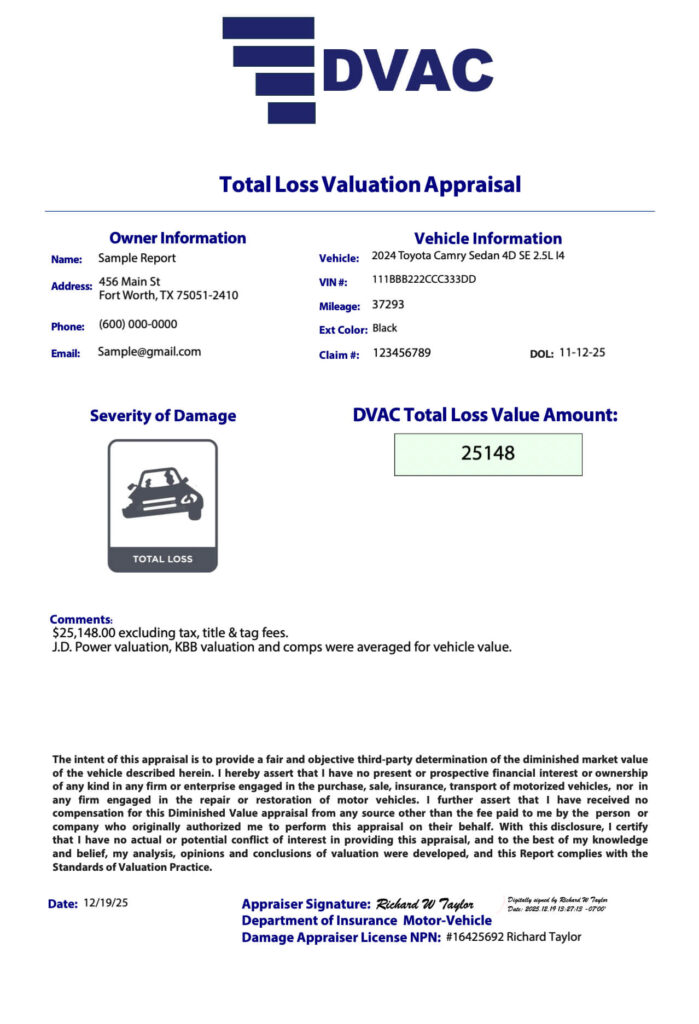
Total Loss Appraisal Report:
Wondering what’s in a DVAC appraisal? Take a look at this recent appraisal we completed for a client.